Showing posts with label Science Fiction. Show all posts

Wednesday, November 7, 2012

Brave New World by Aldous Huxley

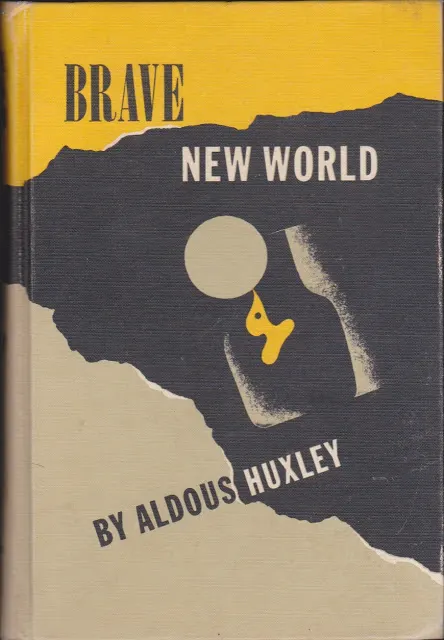
Library edition of Brave New World from some time in the 1960's
First published in the UK in 1932, Aldous Huxley's Brave New World has since become a modern classic of dystopian literature. While it is a great book, there is hardly anything rare about it—with the exception of this obscure made-for-library edition which I haven't encountered again since acquiring the copy pictured. There is no exact publication date anywhere on the inside of the book, but I was able to track it to sometime in the early 1960's through Harper & Row's publication history. I don't know if a definitive publication date exists anywhere though, at least not according to my research. Aside from having wonderful and simple jacket design wrapping around from cover to cover, this edition is remarkable for having the artwork printed directly onto the hardcover. I'm guessing the logic behind this decision was that the publisher assumed these copies would be handled a lot more and wanted to prevent the dust jacket from eventually deteriorating. If you happen on a copy like this one definitely jump on it—especially if you've never read about Mustapha Mond, Soma, and the Savages before.

Simple back cover stating the Harper Crest library edition

Wednesday, September 5, 2012

Solaris by Stanislaw Lem

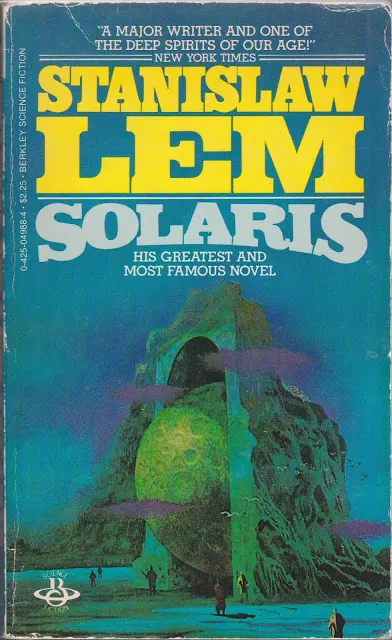
A later printing of Solaris from Berkeley Science Fiction in 1980
As it says on the cover, Solaris is probably Stanislaw Lem's greatest and definitely his most well known work. First published in English in 1970, Polish science fiction writer Lem's novel recounts Dr. Kris Kelvin's travels to the eponymous planet along with his research team to gather data. Solaris is mostly compromised of a strange ocean that the scientists are there to study and communicate with, but what they soon discover is that the highly-sentient planet is actually studying them. Facing each of the scientists with reconstructed people and problems from their past, Solaris is observing the frailty and ultimate inadequacy of human life as they each break down. While Lem's novel has been adapted into several film versions, none of them focuses so much on the extraordinariness of Solaris and its ocean, which Lem believed likely to actually exist, and only showed more of the human weakness instead. This edition features great traditional sci-fi paperback artwork by an unknown cover artist.

Sunday, July 15, 2012

The Corridors of Time by Poul Anderson

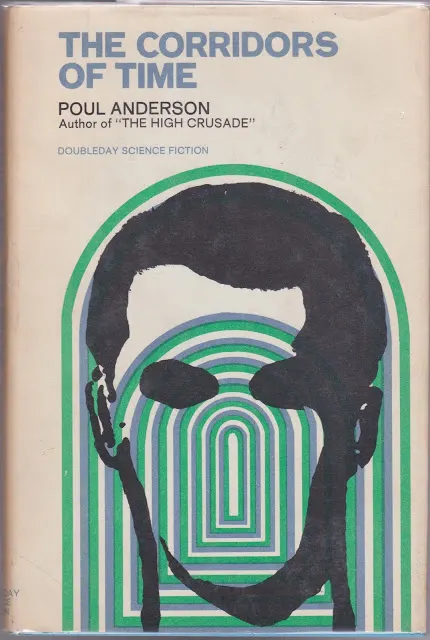
Book club edition of The Corridors of Time from 1965
Published by Doubleday Science Fiction, Poul Anderson's The Corridors of Time is about former death-row inmate Malcolm Lockridge's travels through time, guided by Storm Dalloway, who has just broken him out of prison. In one corridor of time Dalloway was a leader of the Wardens, a group warring against the Rangers, who enlist the help of Malcolm Lockridge before he can settle down in a time period of his choosing. Spanning many centuries and different eras, Anderson's novel can be a little hokey at times but still enjoyable enough to read. Anderson belonged to a sect of science fiction writers who were beyond prolific in their lifetime; this book was probably written among four or five other novels in 1964/1965 and sort of shows. I think this book is most important, though, as a relic from a period of publishing and literary history that no longer exists—incredibly imaginative, pulpy science fiction novels with amazing book design by masters of the genre. The Corridors of Time is a great example of all these things, and features beautiful jacket design by Tom Chibbaro.

Sunday, June 3, 2012

The Foundation Trilogy by Isaac Asimov

Doubleday Science Fiction book club edition of The Foundation Trilogy from 1961
Published between 1951 and 1953, Isaac Asimov's three landmark books collected in this single edition recount the story of Hari Seldon and his plan to save the failing Galactic Empire by forming a new colony to preserve their remaining society, known as the Foundation. In an attempt to maintain the Foundation using a branch of mathematics he developed called psychohistory, Seldon can predict the future on a large-scale and, throughout the trilogy, attempts to navigate the new Foundation to safety from the perils of warring civilizations in the universe. These books are considered a pinnacle of Science Fiction, and mark the beginning of a new kind of writing by the master Isaac Asimov. This book club edition has a great, simple cover, although whoever designed it was never properly credited.

Back cover with author photo of Asimov

Monday, May 21, 2012

This Planet Is Doomed by Sun Ra

First paperback edition of This Planet Is Doomed by Sun Ra
From the back cover by Bhob Stewart: "Beyond the interplanetary theatricality, catchphrases, non sequiturs, science-fictional costumes and kozmic chaos, Sun Ra (1914-1993) was an innovative bandleader, a potent pianist, an electronic keyboard pioneer, a visionary Afrofuturist poet-philosopher, an inventive composer and a prolific recording artist, releasing more than 100 albums totaling over 1000 tunes. Downbeat called him 'the prophet of modern jazz.' When the avant-garde arrived, they found that Sun Ra had already been there. 'I'm a troubleshooter for the cosmos,' said Sun Ra, 'sent here by the outer space beings from my home planet, Saturn.'" Sun Ra was, without question, a weird guy. Collected in this book for the first time by Kicks Books in 2011 are all of Sun Ra's celestial, be-bop musings and stories from space in the form of mostly free-verse poetry. This book is more fascinating than it is good, especially if you're in to Sun Ra at all—it also pioneered a "unique" genre of poetry. The cover design by Patrick Broderick is amazing, especially for something not more than a year or two old.

Tuesday, May 15, 2012

The Man In The High Castle by Philip K. Dick

First book club edition of The Man In The High Castle
Philip K. Dick's nightmarish alternate history was published by Putnam in 1962, and won the Hugo Award the following year. It tells of a world in which the Axis of Evil triumphed in World War II, and in the story's present they effectively run the world. The alternate future begins with FDR being assassinated prior to taking office, and then after the war's outbreak the Nazis take over Russia and later Africa, and everything else goes downhill after that. It is a grim but fun book that makes you think about how close we all came to potentially living in an inane world like the one Dick invites us inside. It's not my favorite book of his, but it definitely possesses all the hallmarks of a Philip K. Dick novel. The stark jacket design by Robert Galster also gets the point of terror across well.

Sunday, May 13, 2012

Movie Magic by John Brosnan

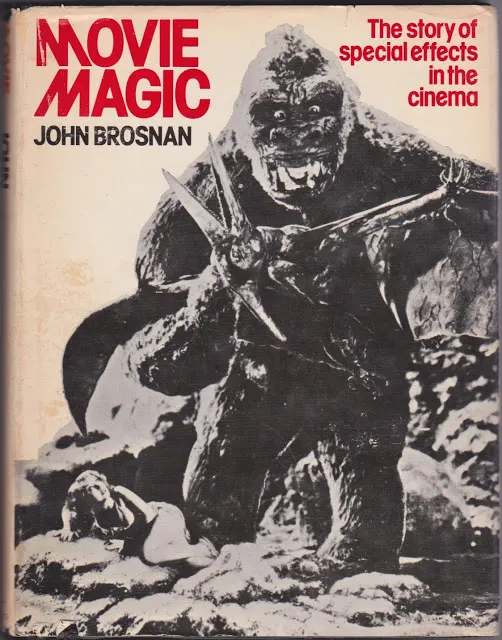
First printing of Movie Magic by John Brosnan
This book is clearly dated, but still interesting. John Brosnan published this book in 1974 on St. Martin's Press chronicling the history of special effects in film. It covers everything from Jason and the Argonauts to 2001: A Space Odyssey, with amazing illustrative pictures and information. Brosnan, who was part film scholar, was also a writer of science fiction in the 1960's and 70's. This book is obviously irrelevant at this point in time, but it serves as a pretty good historical almanac as to how movies were once made. It also has a great cover of a still from the original King Kong movie.

Saturday, May 12, 2012

The Man Who Fell to Earth by Walter Tevis

First Gold Medal paperback of The Man Who Fell to Earth
The above paperback copy isn't in the greatest condition, but it's the only one of The Man Who Fell to Earth I have with this amazing cover. Published in 1963 by Gold Medal following Walter Tevis' success from The Hustler, The Man Who Fell to Earth tells the story of the alien Newton who comes to Earth in a human body to try and rescue his home planet of Anthea. Tevis' novel was adapted into an equally good film in the 1970's, appropriately starring David Bowie as Newton. I'm a big fan of Walter Tevis' work—he only wrote six novels in his lifetime, most of them in varying genres and all of them very solid books.

Wednesday, May 9, 2012

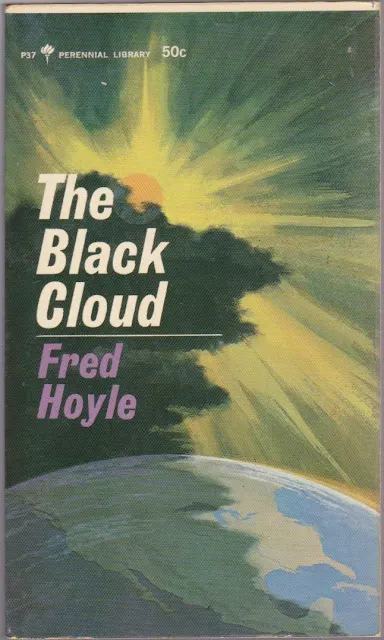
The Black Cloud by Fred Hoyle

First American paperback edition of The Black Cloud
The Black Cloud was Sir Fred Hoyle's first foray into science fiction and is one of the best books to emerge from the tail end of the Golden Age. Published in England in 1957, Hoyle's novel is about a large cloud that enters our solar system and appears to be heading to block all of the Earth's sunlight. I'll leave out the twists and turns that the team of scientists, who are the stars of the book, discover about the cloud, but it is an incredibly gripping, well-written story about a fictional fate for our lives on Earth. Part of what makes the book so great is that Hoyle was a renowned cosmologist and astronomer, and his knowledge of actual science informed his fiction amazingly, particularly in The Black Cloud. A noteworthy biographical fact is that Hoyle was responsible for coining the term "Big Bang" about the theory of how life on Earth began, which he ironically didn't believe in. The cover art, along with most sci-fi books from this period, is exceptional. Illustrated by Charles & Cuffari, the only other cover I've seen from them is the first edition of The Crying of Lot 49 by Thomas Pynchon from the mid-1960's, but beyond that they seem to have done nothing else book-related unfortunately.